
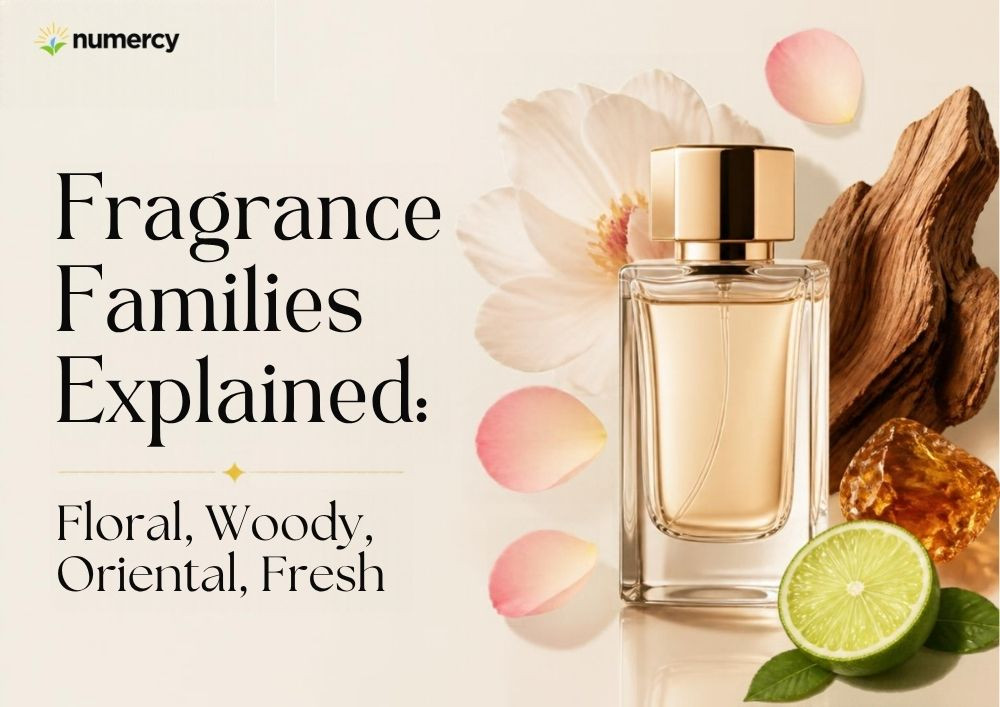
Fragrance Families Explained: Floral, Woody, Oriental, Fresh
Fragrance Families Explained: Floral, Woody, Oriental, Fresh
Perfume descriptions are written in a language most shoppers never learned. "Ambery oriental with a chypre base" is a real phrase, and it is also a wall if you are standing between two bottles trying to decide. Fragrance families are the shortcut that gets you past that wall.
Instead of memorizing hundreds of individual notes, you learn a few broad categories and use them to sort what you smell. That is the entire idea, and it works better than most beginners expect.
What Fragrance Families Actually Are
A fragrance family groups perfumes by their dominant aromatic characteristics and accords. Two bottles land in the same family because they leave the same overall impression, not because they share an ingredient list.
It helps to treat the system as a grouping tool rather than a rule. It is not a strict scientific classification, and no authority enforces the boundaries. Different sources draw the lines in different places, and a single perfume can be classified two ways by two different writers, with both placements defensible.
What the framework does well is describe a perfume's dominant character. Calling a scent floral does not mean every note inside it is a flower, and calling one woody does not mean there is no citrus in the opening. It means that if you had to sum up the scent in a single word, that is the word most people would reach for. Fragrance families are not rigid rules, but they are the single most useful shortcut available to a beginner.
The Main Fragrance Families at a Glance
Standard lists of families tend to include the names below, though labels and groupings shift between sources.
| Family | What the name signals |
|---|---|
| Floral | Scents built around flower-centred impressions; often described as romantic |
| Woody | Scents whose overall reading is wood-derived, even when other notes are present |
| Amber | The family formerly called oriental; amber is the newer label used in its place |
| Fresh | Bright, airy scents; citrus impressions usually sit here or right beside it |
| Citrus | Bergamot, lemon, orange, and grapefruit impressions, often forming a bright opening |
| Aromatic (fougère) | A named family on standard lists; sources use both labels |
| Chypre | A classic family name that appears alongside the others |
| Gourmand | One of the family names included in modern lists |
Some references fold citrus into fresh, while others give it its own slot. Some lists split or merge other categories too. That inconsistency is normal, and expecting it saves a lot of confusion.
Floral: The Family Most People Recognize Instantly
Floral is the easiest family to explain and usually the easiest to spot. The impression that dominates is flowers, and evaluators often use the shorthand "romantic floral" when sorting a scent into this group.
The important nuance is that floral notes can appear in fragrances that belong somewhere else. A woody perfume can hold flowers in its heart and still read as woody overall, because the family describes the dominant character rather than a full ingredient list. Saying a scent is floral tells you what wins, not what is present.
Many people begin their search here, which is also why the family can feel crowded. Two florals can be quite different from each other and still belong to the same broad category, so testing several within the family teaches you more than testing one bottle from each family.
Woody: Grounded and Slow to Fade
Woody covers scents whose overall reading is wood-derived. The dominant character test is what matters here. A woody fragrance can open with citrus and contain flowers in the middle, and it will still be filed as woody, because the wood impression carries the scent from start to finish.
This is the family that trips up shoppers who read the note list instead of the family label. If the opening notes are bright and the heart notes are floral, a quick skim suggests a fresh or floral scent, while the actual wear reads differently. The family label is telling you about the arc of the fragrance, not just its first few minutes.
Oriental and Amber: Same Slot, Two Labels
The word oriental appears throughout older fragrance writing. Many lists now use amber for the same place in the framework, which is why the family is often written as amber, formerly called oriental. If a product page uses one term and you learned the other, you are almost certainly looking at the same category.
Older descriptions sometimes stack labels together, such as an ambery oriental with a chypre base. That is not a contradiction. The writer is signaling that the scent has more than one dominant direction and sits between categories. Compound descriptions like this are the source of most beginner confusion, and recognizing them as deliberate stacking takes the pressure off trying to decode a single correct answer.
Fresh: Bright, Light, and Broader Than It Sounds
Fresh is a wide bucket. It covers scents that read bright and airy rather than heavy, and citrus impressions typically belong here or sit immediately next to it. Citrus fragrances emphasize impressions such as bergamot, lemon, orange, and grapefruit, and they often create a bright opening.
Because citrus materials are so strongly associated with brightness, plenty of shoppers who claim they dislike perfume actually like this part of the map. It is also where the framework starts to blur, since a bright opening can lead into a woody or amber heart. When that happens, the scent still belongs to whichever family dominates the overall impression, not to whichever family owned the first thirty seconds.
Families Beyond the Four in the Title
Aromatic, sometimes called fougère, chypre, and gourmand all appear on standard family lists alongside floral, woody, amber, and fresh. Sources do not agree on whether citrus deserves its own family or lives inside fresh, and they draw the outer edges of chypre and gourmand differently from one another.
For a beginner, the practical move is not to memorize every name at once. Learn the four broad directions first, then add the others only when you keep meeting a scent you cannot place. The extra labels are useful right up until they become homework.
Why Perfumes Refuse to Stay in One Box
A fragrance family is a description of dominant character, not a fixed law, and a perfume can combine several directions at once. That means the same bottle can be listed as floral on one site and woody on another, and neither listing is wrong. The two writers simply weighted different parts of the same composition.
Understanding this changes how you shop. If a bottle is labeled with a family you normally avoid, the label alone is not a reason to skip it. Family placement is a starting filter, not a verdict, and the only reliable test is wearing the scent long enough for the opening to settle.
How to Use Fragrance Families When You Shop
- Start with what you already own. Look up how your current bottle is classified, then treat that as your anchor point instead of guessing from scratch.
- Move one step sideways. If your usual scent is floral, try a woody or fresh option. Adjacent families teach you more than a random pick.
- Read the family label as a filter, not a final answer. Use it to narrow a long list, then judge the rest by wearing the fragrance.
- Give a scent time before deciding. The opening and the drydown are different experiences, and the family usually describes the longer one.
- Keep a simple note on each sample. Recording which family it read as will make your next search much faster.
Where to Start at NuMercy
NuMercy carries designer and niche fragrance names across men's cologne and women's perfume, offered in Eau de Parfum and Eau de Toilette formats. Listings show MSRP alongside sale pricing, which makes comparing two bottles in the same family straightforward once you know which direction you want.
The catalog runs well beyond fragrance as well, covering beauty, skincare, home goods, gifts, and everyday products, with gift certificates available. If you are shopping for someone else, the family framework still applies. Someone who wears a fresh scent most days is a reasonable candidate for another fresh option, and the same logic holds for floral, woody, and amber.
Frequently Asked Questions
What are the main fragrance families?
Standard lists usually name fresh, aromatic or fougère, floral, chypre, woody, amber, and gourmand, with citrus sometimes treated separately and sometimes folded into fresh. The exact lineup shifts between sources, and that is expected. Treat the list as a working set of buckets rather than a fixed catalog of approved categories.
Is oriental the same as amber?
Yes in practice. Amber is the newer label for the family that older fragrance writing called oriental, which is why you will see the category described as amber, formerly called oriental. If a review uses one term and a product page uses the other, you are looking at the same slot in the framework.
Can a woody perfume contain flowers?
Absolutely. A woody fragrance can open with citrus and hold florals in its heart while still reading as woody overall. Family placement reflects the dominant character of the composition, not a restriction on what is inside the bottle. Read the family label for the overall impression and the note list for individual ingredients.
How do I pick a family if I like nothing I have tried?
Look for the closest match among scents you tolerate rather than love, then move one step sideways from it. If everything you have tried felt heavy, test fresh and citrus. If everything felt thin, move toward woody or amber. Small, deliberate shifts beat a broad sweep through every family at once.
Does the family label tell me how long a perfume lasts?
No. Family describes scent character, not wear time or concentration, and one perfume can be classified differently by different sources. If longevity matters to you, check the format listed for the specific bottle and read the retailer's product details, then verify anything unclear with the brand's official information before buying.
Recent Posts
-

Scent Notes Explained: Top, Heart, and Base Notes
Scent Notes Explained: Top, Heart, and Base Notes You spray something on your wrist at a counter, lo …Oct 6th 2026 -

Elizabeth Arden Perfume: Classic Gifts That Still Work
Elizabeth Arden Perfume: Classic Gifts That Still Work Buying perfume as a gift is a gamble in a way …Oct 5th 2026 -
Fragrance Families Explained: Floral, Woody, Oriental, Fresh
Fragrance Families Explained: Floral, Woody, Oriental, Fresh Perfume descriptions are written in a l …Oct 4th 2026